Bijli Bachao: Choosing the Right Air Conditioner to Save Electricity and Reduce Electricity Bills
Air conditioners have become an essential part of modern living, especially during India’s long and intense summer season. Whether in homes, offices, schools, hospitals, or commercial buildings, air conditioning provides the comfort needed to work, relax, and stay productive.
However, one concern remains common among almost every AC owner—high electricity bills.
Many households hesitate to use their air conditioners for longer hours because they worry about increasing power costs. Fortunately, advances in air conditioning technology have made it possible to enjoy the same level of cooling while consuming significantly less electricity.
One of the biggest innovations in recent years is the BLDC (Brushless Direct Current) Air Conditioner, which is designed to deliver superior energy efficiency compared to conventional air conditioners.
The Bijli Bachao initiative encourages consumers to understand the difference between conventional AC technology and modern energy-efficient solutions so they can make informed decisions that reduce electricity bills while protecting the environment.
Why Air Conditioners Consume So Much Electricity
Among all household appliances, air conditioners are one of the largest consumers of electricity.
Several factors influence AC power consumption:
- Compressor efficiency
- Motor technology
- Cooling load
- Room insulation
- Outdoor temperature
- Operating hours
- Maintenance condition
Traditional air conditioners often consume large amounts of electricity because they rely on older motor technologies that operate less efficiently.
As electricity tariffs continue to increase across India, inefficient air conditioners contribute significantly to rising monthly electricity bills.
What is a Conventional Air Conditioner?
A conventional air conditioner typically uses an AC induction motor and traditional compressor technology.
These systems:
- Consume higher electricity
- Experience greater energy losses during operation
- Require more power during startup
- Operate less efficiently under varying cooling loads
Although conventional ACs provide effective cooling, they often do so at the cost of higher electricity consumption.
What is a BLDC Air Conditioner?
A BLDC (Brushless Direct Current) Air Conditioner uses advanced Brushless DC motor technology to drive the compressor and associated components more efficiently.
Unlike conventional motors, BLDC motors use electronic control systems that precisely regulate motor speed based on cooling requirements.
This allows the air conditioner to:
- Consume less electricity
- Deliver faster cooling
- Maintain stable temperatures
- Operate more quietly
- Improve overall system efficiency
In simple terms, a BLDC air conditioner provides the same cooling performance while using significantly less electricity.
Understanding Energy Efficiency in Simple Terms
Energy efficiency means achieving the same result while consuming less electricity.
For example:
- Two air conditioners cool the same room to 24°C.
- One consumes 1.5 units of electricity per hour.
- The other consumes only 0.5–0.6 units per hour.
Both deliver comfortable cooling, but the second air conditioner is far more energy efficient.
That is the primary advantage of BLDC technology.
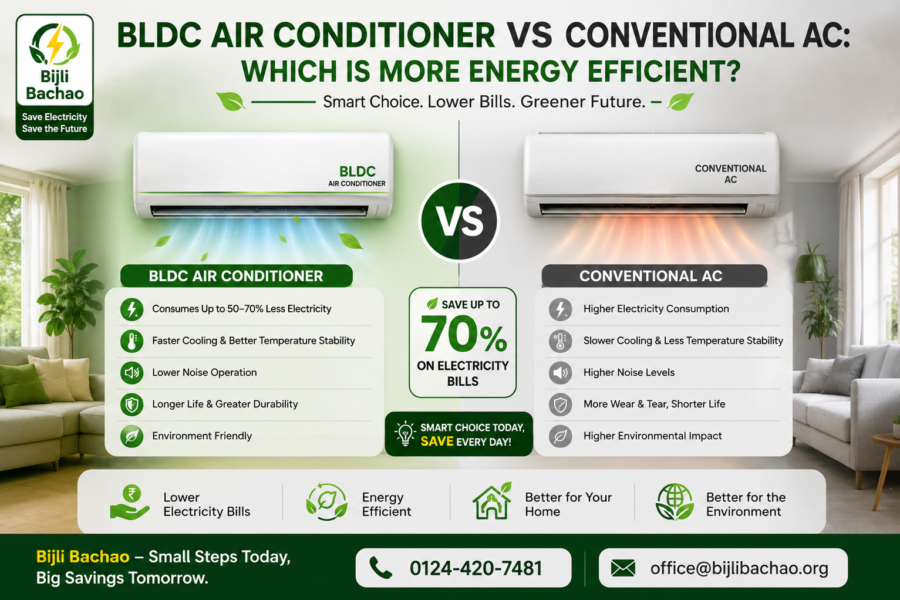
BLDC Air Conditioner vs Conventional AC
| Feature | Conventional AC | BLDC Air Conditioner |
|---|---|---|
| Electricity Consumption | High | Significantly Lower |
| Cooling Performance | Good | Excellent |
| Motor Technology | AC Induction Motor | Brushless DC Motor |
| Power Efficiency | Moderate | Very High |
| Temperature Stability | Moderate | Excellent |
| Noise Level | Higher | Lower |
| Long-Term Electricity Cost | Higher | Lower |
| Environmental Impact | Higher | Lower |
While both systems provide cooling, BLDC technology achieves it using much less electricity.
Real-Life Example: Monthly Electricity Savings
Consider two households using a 1.5 Ton Air Conditioner for 8 hours every day.
Conventional Air Conditioner
- Approximate consumption: 1.5 units/hour
- Daily consumption: 12 units
- Monthly consumption (30 days): 360 units
BLDC Air Conditioner
- Approximate consumption: 0.5–0.6 units/hour
- Daily consumption: 4–4.8 units
- Monthly consumption: 120–144 units
This difference can translate into substantial monthly and annual savings, especially in regions where air conditioners are used extensively during summer.
Benefits of Choosing a BLDC Air Conditioner
1. Lower Electricity Bills
The biggest advantage is significantly lower electricity consumption, helping households reduce monthly energy costs.
2. Same Cooling, Less Power
BLDC technology provides efficient cooling without compromising indoor comfort.
You enjoy the same cooling performance while using much less electricity.
3. Faster Cooling Performance
Advanced motor control allows BLDC systems to reach the desired temperature quickly and maintain it efficiently.
4. Quieter Operation
Brushless motors generate less vibration and operate more smoothly, resulting in lower noise levels.
5. Longer Equipment Life
Reduced mechanical wear improves durability and extends the lifespan of the air conditioner.
6. Better Performance During Voltage Fluctuations
Many modern BLDC air conditioners perform more reliably under varying voltage conditions, reducing operational stress on the system.
Additional Ways to Save Electricity While Using an Air Conditioner
Even the most energy-efficient AC performs better when used correctly.
Maintain Temperature Between 24°C and 26°C
This range provides comfortable cooling while minimizing electricity consumption.
Clean Filters Regularly
Dirty filters reduce airflow, forcing the compressor to work harder.
Close Doors and Windows
Prevent cool air from escaping to reduce compressor workload.
Use Curtains During Peak Sunlight
Blocking direct sunlight reduces heat entering the room.
Turn Off the AC When Not Needed
Avoid unnecessary operation in empty rooms.
Schedule Regular Maintenance
Proper servicing improves efficiency and extends equipment life.
Environmental Benefits of BLDC Air Conditioners
Reducing electricity consumption benefits more than just your monthly budget.
Lower electricity demand helps:
- Reduce carbon emissions
- Decrease dependence on fossil fuels
- Lower pressure on power generation systems
- Support India’s energy conservation goals
- Promote sustainable development
If millions of homes adopt energy-efficient air conditioners, the collective impact on electricity demand and environmental sustainability can be substantial.
The Vision Behind the Bijli Bachao Initiative
The Bijli Bachao initiative encourages individuals and organizations to embrace modern energy-efficient technologies that reduce electricity consumption without compromising comfort.
Its key objectives include:
- Promoting energy-efficient appliances
- Encouraging adoption of advanced cooling technologies
- Reducing electricity wastage
- Lowering electricity bills
- Building a more energy-conscious India
By educating consumers and supporting smarter technology choices, Bijli Bachao aims to create a future where comfort and sustainability go hand in hand.
Conclusion: The Smarter Choice for Energy-Efficient Cooling
Choosing the right air conditioner is not just about cooling—it is about long-term savings, energy efficiency, and environmental responsibility.
While conventional air conditioners continue to provide effective cooling, BLDC air conditioners offer the same level of comfort with significantly lower electricity consumption, making them a smarter choice for modern homes and businesses.
If your goal is to enjoy powerful cooling while reducing electricity bills, investing in energy-efficient air conditioning technology is one of the best long-term decisions you can make.
The message of Bijli Bachao is simple:
Choose smarter technology.
Save electricity.
Reduce electricity bills.
Protect the environment.
Small technology upgrades today can create lasting financial and environmental benefits for families, businesses, and the nation.
📞 Call: 0124-420-7481
📩 Email: office@bijlibachao.org